
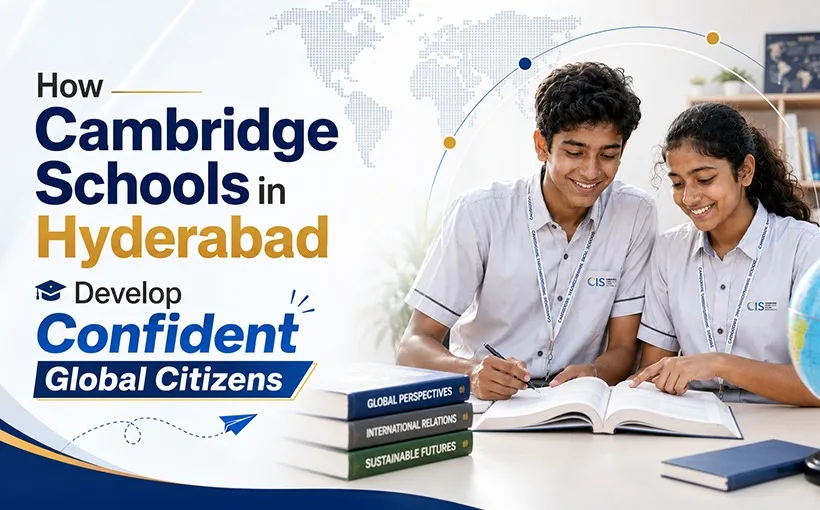
The world that children will grow up in as adults will be more connected than ever. They can study in one country, work with people from other countries, and resolve problems that have widespread geographical and cultural implications. To get children ready for this world, an education that involves more than academic knowledge is needed.
This is one of the factors that has led many parents to want to use the Cambridge Schools in Hyderabad, which provides children with an education that has an international framework. International education makes it possible to realize the benefits of having a global viewpoint, which helps students understand various viewpoints, be self-assured communicators, appreciate diversity, and master the art of living in a connected world.
On the other hand, Candiidus International School believes that the aim of education should not be limited to achievement in the classroom. Children are encouraged to gain confidence, awareness, and abilities that will allow them to become socially responsible individuals.
What Does It Mean to Be a Global Citizen?
Being a global citizen is more than just knowing about countries. It entails recognizing that cultures, experiences, points of view, and problem-solving methods vary from one person to another.
A globally-aware student acquires the following skills:
-
Respecting others’ viewpoints
-
Interacting with individuals from various backgrounds
-
Understanding global issues
-
Taking responsibility for one’s actions
-
Collaborating with others.
Such qualities will help the children in their life.
Building Confidence Through Communication
Having confidence is vital in one becoming a global citizen. It is crucial that students know how to express their thoughts as well as to listen to and respect what others have to say.
Classroom discussions, speeches, group projects, and collaboration are many opportunities given to children so that they could develop communication skills.
At Candiidus International school, the students are encouraged to be proactive. Talking about their opinions, presenting an idea, asking a question, or explaining a project will assist them in getting used to the idea of communicating.
These skills will be useful academically and in society.
Learning to See More Than One Perspective
Young ones learn about life and nature through their own experiences. The classroom helps them to realize that a single question may have many different answers. For instance, by investigating an environmental issue, learners can find out what a community thinks about this issue, what the companies say about it, what scientists and politicians think. One more thing that is worth knowing is that in our world where students learn from so many sources of different information, it is important to have this ability.
Parents looking for Cambridge schools in Hyderabad must think about this point while choosing an educational institution where their children will study.
Connecting Classroom Learning With the World
Global citizenship becomes meaningful when students can connect academic concepts with real-world situations.
Subjects such as geography, science, social studies, languages, and technology can provide opportunities to explore topics that affect communities around the world.
Students may investigate questions such as:
-
How can communities use resources responsibly?
-
Why do different cultures develop different traditions?
-
How does technology connect people across countries?
-
What can individuals do to support their communities?
-
How do global events affect everyday life?
These questions encourage children to see learning as something connected to the world rather than limited to textbooks.
Encouraging Curiosity About Different Cultures
Getting acquainted with other cultures teaches kids that differences should be embraced, not feared.
Learning about languages, customs, cuisines, arts, festivals, history, and daily lives promotes curiosity about the world. It also instills in children a willingness to face new situations.
A child who learns to appreciate diversity in school may have an easier time cooperating with people from various cultures in adulthood.
Developing Collaboration and Leadership
Cooperation is essential for successful international citizens to collaborate with each other. It gives an opportunity to be trained in how to listen and communicate, share responsibilities, negotiate ideas, and ensure that the common goal is achieved.
Teamwork teaches students different leadership styles. During the group project, a participant may become a leader, and in the upcoming project will be playing another role; for instance, she might become a researcher, presenter, designer, or coordinator.
All these become apparent to today’s children, who learn that leadership is not just about issuing commands, but also about listening to others.
Preparing Students to Handle a Changing World
It’s incredibly hard to predict what the future will hold in terms of development. Growing sectors and industries, emergent technologies, societal issues, and ecological issues can present both challenges and opportunities for current students.
Instead of teaching them simply how to get ready for a particular future, learning institutions should devote their efforts to developing adaptable learners.
Cambridge schools in Hyderabad can be of assistance in this process, as they allow their students to develop critical thinking skills, effective communication, creativity, and learning skills.
At Candiidus International School, these qualities are part of a larger system of education.
Technology and Global Awareness
The creation of technology has improved students’ abilities to find resources and talk to people over long distances. When used wisely, digital learning allows children to see things from new points of view, meet new ideas and use materials that are not available at home.
However, gaining access to information must be accompanied by understanding of responsibilities. University students have to know how to evaluate information sources, recognize trustworthy information, protect their digital identities and communicate in an appropriate manner online.
By boosting digital literacy together with academic education, students become better participants in the digital world.
The Candiidus Approach to Global Citizenship
Candiidus International School aims to create an environment where students can develop academically while also becoming confident, thoughtful, and responsible individuals.
Through communication, collaboration, inquiry, creative activities, and exposure to wider perspectives, students are encouraged to understand their role within an increasingly interconnected world.
The purpose of global education is not to make every child the same. It is to help children appreciate differences while developing the confidence to contribute their own ideas.
For families exploring Cambridge schools in Hyderabad, Candiidus International School offers an environment where students can build the knowledge, confidence, and perspective needed to engage with the world around them.
A confident global citizen is not simply a child who knows about the world. It is a child who is curious about it, respectful toward others, willing to learn, and prepared to make a positive difference.
FAQs
1. What does it mean to be a global citizen?
A global citizen understands and respects different cultures and perspectives while developing the ability to communicate, collaborate, and contribute positively to society.
2. How do Cambridge Schools in Hyderabad encourage global awareness?
They can encourage students to explore different perspectives, understand international issues, collaborate with others, and connect classroom learning with real-world situations.
3. How does Candiidus International School develop student confidence?
Students are encouraged to participate in discussions, presentations, projects, collaborative activities, and other learning experiences that allow them to express their ideas.
4. Why is cultural awareness important for children?
Cultural awareness helps children appreciate differences, develop empathy, communicate respectfully, and become more comfortable interacting with people from different backgrounds.
5. How does global citizenship prepare students for the future?
It helps students develop adaptability, communication, critical thinking, collaboration, and an open-minded approach that can benefit them in higher education and future careers.
Keep reading
Related articles
How Cambridge Schools in Hyderabad Build Critical Thinkers and Independent Learners
Discover how Cambridge Schools in Hyderabad help students develop critical thinking, independence, problem-solving skills, and confidence for future success.
Discussion
Comments
No comments yet. Be the first to share your thoughts.
Leave a comment
Comments are reviewed before they appear on this page.